
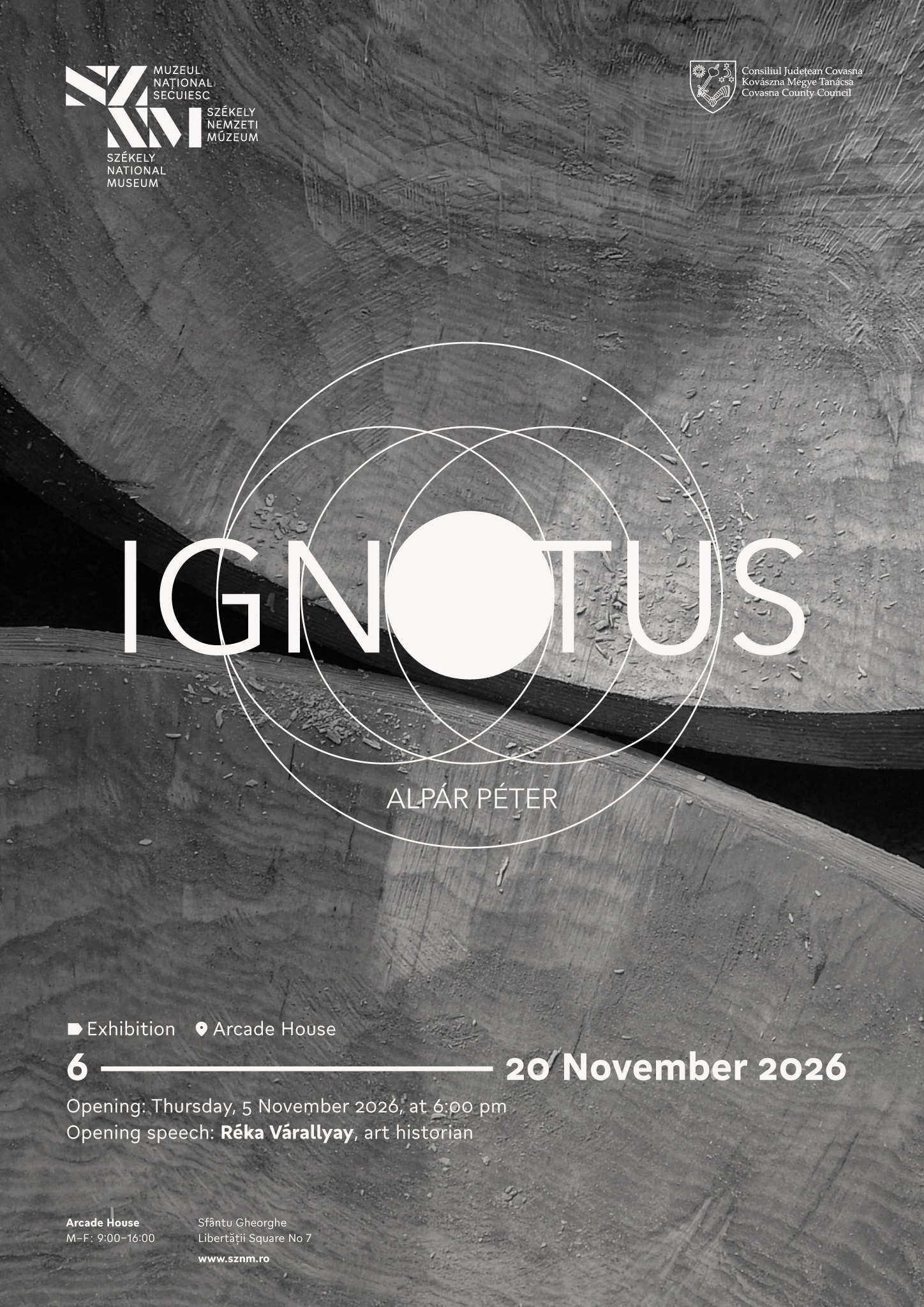
IGNOTUS
Alpár Péter


The opening of IGNOTUS, an exhibition by visual artist Alpár Péter, will take place on Thursday, 5 November, at 6 p.m. at the Arcade House in Sfântu Gheorghe. The exhibition will be opened by art historian Réka Várallyay and will be on view until 20 November.
Visual artist Péter Alpár began his professional career in Sfântu Gheorghe more than three decades ago. The city’s artistic life in the 1990s fundamentally shaped the perspective that has guided his artistic practice over the decades since. His first solo exhibition in his hometown offers an insight into this way of thinking: a free-ranging visual exploration that ventures along new paths into the unknown — into IGNOTUS.
The exhibition focuses primarily on works created in situ, within the context of specific environments, mostly in distant countries, and which are less familiar to audiences back home. These works are presented chiefly through documentary materials recording the creative processes behind them. The exhibition space brings together material artefacts, diaries, sketches, original plans, and giclée prints of photographs documenting the completed works.
Where, in fact, is the true space of an artwork? In the desert of a distant country, in the early hours of the morning? In a print displayed on a gallery wall? Or in the artist’s inner, intellectual space? Perhaps in all three places at once? In how many different forms can an artwork continue to exist? How does the artist perceive it, and how can they make it visible to the audience?
The works on display have been selected from three series.
The first series comprises installations constructed from sculptural elements carved from wood by the artist — functional sculptures — sometimes incorporating other materials. These works are integrated into specific natural or urban environments, seeking an interactive relationship with both the surrounding space and the audience.
The second series also consists of abstract works: large-scale drawings created in untouched natural environments through the artist’s performative presence.
The third group places the performative presence itself, imbued with the significance of gesture, at its centre. It is represented through photographic documentation of performances in which gesture becomes a form of expression, alongside material artefacts associated with them.
Rather than offering a retrospective overview of the artist’s body of work, the exhibition seeks, above all, to create an honest dialogue with the audience.